
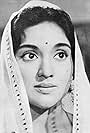
- Vyjayanthimala Raman entered the Indian National Congress in 1984 following the invitation of Prime Minister Indira Gandhi. The actor contested the 1984 General Election for the Chennai South constituency and defeated Era Sezhiyan to become a Member of the 8th Lok Sabha. She secured a second term in the 1989 General Election by defeating Aladi Aruna and served in the 9th Lok Sabha until 1991. President Dr. Shankar Dayal Sharma nominated her to the Rajya Sabha in 1993, where she served a six-year term representing the Indian National Congress until 1999. She resigned from the party on 28 August 1999, citing a departure from the ideological principles established under the leadership of Mahatma Gandhi, Jawaharlal Nehru, and Rajiv Gandhi. The actor subsequently joined the Bharatiya Janata Party in September 1999.
- Asha Parekh served as a background dancer in several productions starring Vyjayanthimala before her 1959 debut as a leading lady in Aasha (1957). During the 1966 filming of Amrapali (1966), Parekh visited the set specifically to observe Vyjayanthimala's performance and technical dance execution. Parekh later portrayed a dedicated fan of Vyjayanthimala in Jawan Muhabat (1971). The two performers engaged in social lunches throughout their careers. "Asha is a very nice girl," Vyjayanthimala stated during a 2016 retrospective interview.
- Vyjayanthimala received the Sangeet Natak Akademi Award in 1968 for her contributions to Bharatanatyam, representing a pivotal shift from her primary identity as a film star to a classical exponent. She released a specialized research publication and documentary titled "Sanga Tamizh Maalai" which focuses on the preservation of ancient temple dance forms and the traditional music associated with Alvar literature.
- Vyjayanthimala secured the Filmfare Award for Best Actress on three occasions, earning the honors for her performances in Sadhana (1958), Gunga Jumna (1961), and Sangam (1964). She holds the distinction of being the first South Indian actress to achieve the status of a national superstar in the Hindi film industry. Her success established a professional precedent that facilitated the subsequent careers of other South Indian actresses, including Hema Malini and Sridevi, within the Mumbai based production landscape.
- Vyjayanthimala maintains a rigorous specialization in Bharatanatyam, training under gurus Vazhuvoor Ramiah Pillai and K. P. Kittappa Pillai. She secured the distinction of being the first South Indian actress to achieve national stardom in the Hindi film industry, effectively shifting the industry capital from Calcutta to Bombay. Her technical proficiency in classical dance forms established a new production standard for female protagonists, mandating formal dance training as a prerequisite for leading roles.
- Vyjayanthimala entered the film industry through the AVM Productions Tamil feature Vazhkai (1949) (1949). Director M.V. Raman, a family friend of the actress, cast her in the lead role after spotting her during a dance performance in Madras. Her mother, Vasundhara Devi, had previously established a career as a prominent actress in Tamil cinema during the 1940s. The production underwent significant commercial success, leading to a Hindi language remake titled Bahar (1951) (1951). Vyjayanthimala reprised her role for the Hindi version, marking her debut in the North Indian film market.
- The actress became the first individual to refuse a Filmfare Award in 1957. She declined the Best Supporting Actress trophy for her portrayal of Chandramukhi in Devdas (1955), asserting that her character was a lead role parallel to Suchitra Sen, who played 'Paro'.
- The actress established a significant professional partnership with Dilip Kumar, appearing in seven films together including Devdas (1955), Naya Daur (1957), Madhumati (1958), and Gunga Jumna (1961). Collaborations with Kishore Kumar yielded major commercial successes in the romantic comedy genre, specifically New Delhi (1956) and Aasha (1957).
- Fell in love with Raj Kapoor's personal physician, Dr. Bali, who treated her for pneumonia after she fell into the lake while shooting for a film. The two grew close and later married and had a child, Suchindra Bali. Vyjayanthimala subsequently decided to leave films while still at the top, and immersed herself in raising her son.
- The Sangeet Natak Akademi awarded her the Sangeet Natak Akademi Award for lifetime achievement in Bharatanatyam in 1982. This recognition remains the highest Indian honor for practicing artists in the performing arts. She received the Filmfare Lifetime Achievement Award during the 41st Filmfare Awards ceremony in 1996 for her extensive contributions to Indian cinema.
- Her husband, Dr. Chamanlal Bali introduced Vyjayanthimala to the sport of golf following their marriage in 1968. She transitioned to competitive play in 1970 after relocating from Mumbai to Chennai. She achieved a 15 handicap during her peak competitive years and participated in the National Golf Championship. Her initial tournament victory occurred at the Ladies Open in Delhi, where she competed as a 32 handicapper. She later served as the Lady Captain at her home club and maintained an active playing schedule into her eighties.
- The production for Deewaar (1975) originally offered the role of Sumitra Verma to her before casting Nirupa Roy. She declined the mother's role because the script required her to play the parent of characters portrayed by Amitabh Bachchan and Shashi Kapoor. She had previously performed as a romantic lead opposite both actors' contemporaries and frequent co-stars, such as Dilip Kumar and Raj Kapoor, and viewed the transition to maternal roles as premature for her career trajectory.
- Vyjayanthimala maintained a position as the third highest paid actress in Hindi cinema between 1955 and 1961. She ascended to the status of the highest paid actress from 1962 to 1965, sharing this financial rank with Sadhana. This period preceded her tenure as the second highest paid actress from 1966 to 1967, a rank held alongside Mala Sinha, Nanda, and Waheeda Rehman.
- Vyjayanthimala performed a Bharatanatyam recital for Pope Pius XII at age five during a 1940 visit to the Vatican. She received a gold medal for this presentation during her first international tour with her family.
- Vyjayanthimala Bali maintains a primary residence in Chennai, Tamil Nadu, following her departure from the Hindi film industry in 1970. She relocated to the city after her marriage to Dr. Chamanlal Bali on March 10, 1968. Her public appearances in Mumbai remained infrequent throughout the early 21st century, with documented visits typically restricted to major industry awards or state functions.
- In 2007, she published her autobiography, Bonding, through Stellar Publishers, providing her account of production history and personal milestones.
- Son Suchindra Bali aka Pravin Bali is actor.
- Has three step children from her husband Dr.Chaman Bali's first marriage. He was previously married to Rubi Bali. The three step children are Ratan Bali (Born1956), Rajan Bali (Born 1958), Raman Bali ( Born 1960).
- Vyjayanthimala Bali received early exposure to Carnatic music through the regular audition of Vedic chants and devotional hymns within her domestic environment. Her maternal grandmother, Yadugiri Devi, supervised this cultural immersion to establish a foundation in classical performing arts.
- In her heyday, Vyjayanthimala was the subject of many controversies, particularly for her misconstrued relationships with her co-stars. In the late 1950s, Vyjayanthimala was linked by gossip magazines with Dilip Kumar, who has acted with her the most compared to any other actress, which resulted in great on-screen chemistry between them. While working for his home production Gunga Jumna (1961), Kumar reportedly handpicked the shade of sari that Vyjayanthimala would wear in every scene.
- The Government of India conferred the Padma Vibhushan, the nation's second-highest civilian award, upon Vyjayanthimala in 2024 for her contributions to the arts.
- She prays to Goddess Saraswati before any public performance to gain her blessing.
- Vasundhara Devi, mother of Vyjayanthimala, attained significant professional status as a leading actress in Tamil cinema during the 1940s. Her performance in Mangamma Sapatham (1943) established a historical commercial milestone as the first Tamil production to receive a colossal hit designation at the box office.
- Vyjayanthimala maintains a lifelong devotion to Aandaal, the 8th-century Tamil saint and the only female figure among the 12 Alvar saints of Vaishnavism. This spiritual focus heavily influences her classical dance repertoire, specifically her choreography of the Thiruppavai, a collection of thirty stanzas authored by the saint. She performed these hymns extensively during her career, including a notable presentation at the United Nations General Assembly in 1970 to mark the 25th anniversary of the organization. Her dedication to the Alvar tradition extends to regular participation in the Margazhi season festivals in Chennai, where she interprets Aandaal's poetry through Bharatanatyam.
- Vyjayanthimala adheres to Vaishnava Hindu religious practices. She maintains a strict vegetarian diet.
Contribute to this page
Suggest an edit or add missing content
