
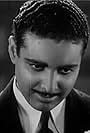
- Born
- Died
- Nickname
- The Black Valentino
- Lorenzo Tucker in his prime was billed and known as "The Black Valentino," named after Rudolph Valentino, because of his tall, dark, dashing good looks, muscular built, secret charm and coolness. Tucker was one of Black Cinema's most popular leading actors, appearing in close to 20 films. He started acting at Temple University in Philadelphia where he contemplated medicine but caught the acting bug. He perfected his art by appearing in college plays and got his entry into movies from legendary film maker Oscar Micheaux. Lorenzo's prime was from the late 1920s to the end of the 1930s. He became a bona fide movie star to Black America, he was often mentioned in the leading Black newspapers.
Tucker was an Oscar Micheaux discovery and appeared in many of his important films, one of the most controversial was "Veiled Aristocrats" where Lorenzo played a Negro who successfully passes as white and returns to the family to coax his sister into passing for white like him. Throughout the movie, Lorenzo plays the part of a white man and plays it very realistically. His light complexion played a part in his exit from movies, it was hard attaining success in mainstream films, particularly Hollywood, because he was considered not Black enough. He had success on the stage in Broadway productions, "The Constant Sinner," "Ol' Man Satan," and "Humming Sam." In one controversial play on stage in Washington, D.C., he played the pimp to legendary Mae West's prostitute. It was to be her last stage role. A scene called for Lorenzo to kiss Mae West, and the theater critics of the capital city's press were outraged to see a Black man kissing a white woman. They demanded the scene to be stricken from the play. Never short of spirit, not one to seek an escape from battle, the show's star never wavered. Miss West would stand for no alteration in the play. It left the city.
Tucker had success outside of show business, service in the army during World War 2 led him to become an autopsy technician for the medical examiner's office in New York City. He handled many celebrities, gangsters and prominent figures like Malcolm X and Nina Mae McKinney in his line of work that in a way still kept him connected to show business. He was also a talented photographer.
Tucker was the only Black involved in Black Cinema who people could locate and who lived long enough to see his talent and contributions recognized, appreciated and awarded. In 1974, he traveled to accept nomination into The Black Film Makers Hall of Fame which he always cherished. He was often compared to early Hollywood actor William Powell because of resemblances in looks and nonchalant acting. He died of lung cancer at his Los Angeles home and was interred at Riverside National Cemetery in Riverside, California.
- IMDb mini biography by: Alicia T. (MsLadySoul@aol.com)
- SpousePaulina Segura(? - August 19, 1986) (his death)
- In 1974 he was inducted into the Black Filmmakers Hall of Fame.
- Was cast in Mae West's Broadway play "The Constant Sinner" in 1931. According to Laura Wagner in her article on Tucker for Films of the Golden Age, Issue #79, Winter 2014-2015, Tucker was originally set to star opposite West as gangster Money Johnson but she was met with strong resistance by audiences and theatre owners and was forced to replace him. Tucker took a minor role in the show instead. West always cast black actors in her shows and, as such, Tucker referred to her as one of "the greatest ladies of the theater.".
- At 19, he dropped out of Temple University and worked as a hotel waiter in order to pursue his career. He eventually found work performing an adagio dance with Rae Hewitt and performed on the black vaudeville circuit. As such, he became known for a time as "The Colored Valentino". He was also known as the "John Gilbert of the Colored Race" and the "Sepia William Powell".
- Performed with the Lafayette Players on the Harlem stage. He later formed the Negro Drama Players and Universal Theater in the 1950s.
- Worked as an emcee and straight man in vaudeville for such celebrities as Bessie Smith, Evelyn Nesbit, Mamie Smith, Tim Moore and Jimmy Savo.
- [on Oscar Micheaux] Why, he was so impressive and so charming that he could talk the shirt off your back.
- As a child I would go around reciting poems and famous passages, things like that. Things I was taught by rote, or conversation I had overheard and just remembered. I wanted, I guess, to be seen.
- I was never called [the Black Valentino] because we never used the word 'black' like that in those days. [Filmmaker Oscar] Micheaux only called me 'the Colored Valentino,' nothing else. In fact, if you really want to know, I was even lighter than Valentino himself.
- I could have passed for white and left Harlem behind, but I didn't. Maybe that was a mistake as far as my career was concerned, but I didn't do it. It would have been easier that way, passing for white and keeping my past a secret, like others did, but I chose to be considered as colored. You see, I still want to prove that the Negro race is not all black-skinned; we're all shades of the rainbow.
Contribute to this page
Suggest an edit or add missing content
